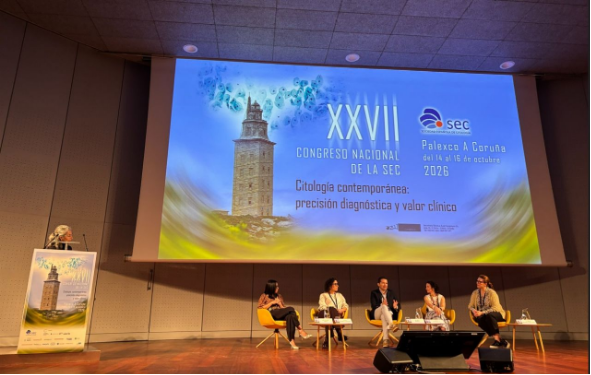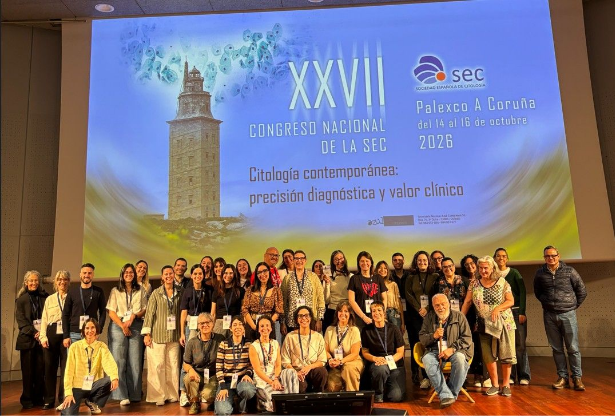
At the XXVII Spanish Congress of Cytology, held in A Coruña from 14 to 16 October 2026, the Spanish Society of Cytopathology (SEC) hosted the round table “Compartiendovalores con sociedades amigas” – Sharing values with partner societies. It continues the dialogue that began at the XXXII SLAC Congress in Buenos Aires in 2025, where a round table on the role of scientific societies in cytopathology education led to a joint publication: Role of Scientific Societies in Continuing Education in Cytopathology: Present and Future Perspectives (Abad-Licham M, et al. Cytopathology. 2026;37(5):472–484. doi:10.1111/cyt.70077).
In A Coruña, five societies from Europe, North America, and Central and South America shared the table:
- Milagros Abad, representing the Latin American Society of Cytopathology (SLAC), Instituto Regional de Enfermedades Neoplásicas Norte, Peru
- Rúben Roque, representing the Portuguese SocietyofCytology (SPC), Instituto Português de Oncologia de Lisboa Francisco Gentil, Portugal
- Frida Rosenblum, representing the American Society of Cytopathology (ASC), University of Alabama at Birmingham, USA
- Carme Dinarès, representing the Spanish Society of Cytopathology (SEC), Hospital Universitario Vall d’Hebron, Barcelona, Spain
- Cioly Rivero Colmenarez, representing the European Federation of Cytology Societies (EFCS), Unilabs, Lausanne, Switzerland
The discussion was dynamic and highly interactive. The panel compared models of specialized training in cytopathology and of professional training for cytotechnologists. Curricula, certification and professional recognition still vary considerably across Europe and worldwide.
The Portuguese model, presented by Rúben Roque, served as a reference throughout. Its structured academic and specialized pathway for cytotechnologists is a benchmark at European and international level.
A clear message emerged: quality begins with professional training, and our technical and diagnostic work is built on that foundation. The panel also called for cytotechnologists to be involved much more actively at every level: in academia, in education, at scientific meetings and congresses, and in the work of our societies.
All panelists agreed that collaboration between societies is essential. Many of our challenges in training, quality and workforce are shared, and so are many of the solutions. From Buenos Aires to A Coruña, the conversation goes on.
Carme Dinarès
President, Spanish Society of Cytopathology (SEC)